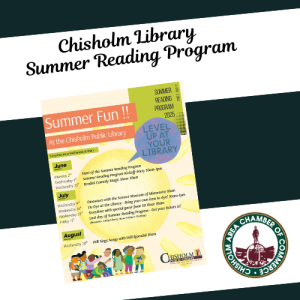
Chisholm Library Summer Reading Program is a great way to keep your kiddos learning while on summer break. It starts June 2nd through July 11th. Read books to get tickets to redeem for prizes. Turn your tickets in no later than Friday July 11th between 9:00am-12:00pm.
Some special events are:
They are having a kickoff party on Wednesday June 4th from 101am-1pm
June 25th don’t miss the Brodini Comedy Magic Show at 10:00am.
July 9th – Dinosaurs with the Science Museum of MN at 10:00am
July 16th- Tye Dye at the Library – Bring your own item to dye. 10:00am-1:00pm
July 23rd- Storytime with a special guest from 30 West at 10:00am
August 20- Sing songs with Will Bjorndal – 10:00am
Check out their Facebook Page for information on the upcoming events. If you have any questions please call 218-254-7913 or email katie.christenson@alslib.info
How Summer Reading Programs Help
1. Prevent Learning Loss
-
Studies show that students—especially in low-income families—can lose 2+ months of reading achievement over summer.
-
Students who read just 4–6 books over the summer often maintain or improve their reading levels.
2. Promote a Reading Habit
-
Summer programs give kids choice and freedom, which helps foster a lifelong love of reading.
-
Structured programs (like those at libraries) add accountability and motivation through rewards, badges, or events.
3. Build Confidence and Skill
-
Independent reading strengthens vocabulary, comprehension, and fluency.
-
Kids come back to school more confident and ready to learn.
Library Fun Facts
1. The world’s oldest known library?
-
The Library of Ashurbanipal (7th century BCE) in ancient Nineveh (now Iraq) is considered the earliest known library. It housed thousands of clay tablets written in cuneiform!
2. Libraries loan more than books
-
Modern libraries lend out bicycles, seeds, musical instruments, cake pans, power tools—even Wi-Fi hotspots and video games.
3. There’s a library with no books
-
The BiblioTech in San Antonio, Texas, was the first all-digital public library in the U.S. when it opened in 2013. No physical books—just eBooks and tablets!
4. Largest library in the world?
-
The Library of Congress in Washington, D.C., holds over 170 million items—including books, recordings, maps, photos, and even comic books in 470+ languages.
5. Books can travel… a lot
-
In 2016, a book returned to a library in Australia was over 100 years overdue! It was a copy of Great Expectations borrowed in 1908.
6. Libraries get creative with architecture
-
There’s a library shaped like a giant bookshelf in Kansas City, MO, and the futuristic Tianjin Binhai Library in China looks like it has endless waves of books on its curved walls (some are just printed images!).
7. You can check out people
-
The Human Library movement allows you to “borrow” a person for a conversation—someone who’s volunteered to share their life experiences, like a refugee, an activist, or a recovering addict.
8. Bookmobiles still exist
-
Mobile libraries, aka bookmobiles, bring books to people in rural or underserved areas. Some even travel by camel, donkey, or boat in remote regions!
9. Libraries support more than reading
-
Many libraries offer career help, homework tutoring, tech training, makerspaces, ESL classes, and even legal clinics—all for free.
10. Silent doesn’t mean inactive
-
Libraries are bustling community hubs, often hosting storytimes, concerts, board game nights, coding workshops, and film screenings.